The following information was taken from this website: drumcorps.fandom.com
Queensmen History
Formed on the evening of Friday, January 10, 1964, the Queensmen developed rapidly, first appeared publically in May in the Kenosha Memorial Day Parade. The Queensmen began touring on July 4th, and were invited to perform at the opener of a Milwaukee Braves baseball game that August. The corps entered field competition in 1965.
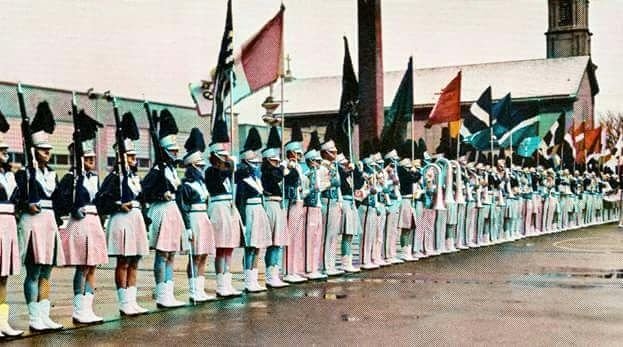
The royal blue/white-uniformed Queensmen became known for their brash, powerful style and for pioneering a number of various innovations including G-F-F# bugles, tuned bass drums and unusual instrumentation in many national and regional contests throughout eighteen states in the corps' six seasons on the road, including Top Ten finishes in the first US Open Championships of 1968 and 1969. The Queensmen's massive collection of hundreds of trophies, plaques, certificates and awards was on permanent display in a rented storefront at 2106 44th Place in Kenosha.
The Queensmen also competed with two color guard units (the Queensmen and the Regents in Midwest Color Guard Circuit competitions, winning several MCGC championship titles and celebrating one undefeated season (1967).
By the summer of 1969, a combination of increasing operational costs, the "aging-out" of a number of members within the bugle sections (though the drumline remained intact) and internal strife within the council of the sponsoring Holy Rosary Church parish made it obvious that the 1970 Queensmen would be competitively weaker.
And so to salvage the 1970 season, a mutual agreement was forged with the neighboring Racine Explorer Scouts, with whom the Queensmen had always enjoyed rapport. The Racine Scouts agreed to transport and accomodate any Queensmen who wished to participate for their 1970 season, and to re-release any at seasons-end who wished to rejoin the Queensmen's rebuilding efforts for the 1971 season. About twenty Queensmen chose to participate in the 1970 combined program, and all returned to the Queensmen that autumn, but equipment replacement was still to be an insurmountable obstacle and by early 1971 the decision to become inactive, though painful, was unavoidable.
On January 10th, 1984, the twentieth anniversary of the Queensmen, a hundred alumni gathered at "Scotty's Bar" (owned by an alumnus) to reminisce. As the evening wore on, the concept of making a comeback appearance was proposed, which was finally realized on the hot Sunday afternoon of July 6, 1986 as the Queensmen and Queensmen Squires alumni marched together at a well-publicized hometown reunion in the Kenosha Civic Veterans Parade.
Today, the Queensmen are remembered by the recordings and photos made over their six-season (or seven, if the 1986 alumni reunion can be counted) history.
Motto
Dignity - Excellence - Responsibility - Fellowship
.
History of the Squires
Both Kenosha corps were part of a number of parish-sponsored drum and bugle corps once prevalent across the Midwestern and Eastern United States. The Queensmen Squires were founded on Friday, January 17th, 1964, one week after the Queensmen due to the large response at its organization.
(Note: early on, the junior corps was called just 'the Squires'.)
Both the Queensmen and the Queensmen Squires made their premiere appearances that May at Kenosha's Memorial Day Parade.
By 1965 the Queensmen Squires were competing in Class C contests.
The senior Queensmen always strongly supported their junior corps, and by 1967 the by-now polished Queensmen Squires under directors John and Gail Isermann began a three-year nearly-undefeated period of first-place victories in the active Midwestern Class C circuit.
By 1969, following internal strife within the parish council of their sponsoring church, the Queensmen Squires and parent Queensmen became independent of Holy Rosary.
After the Queensmen effected a merger with the Racine Explorer Scouts for the 1970 season, the Queensmen Squires continued on as a parade corps, making their final appearance at the Chicago Columbus Day Parade that October 12th.
In 1984, over two hundred former Queensmen Squires members, families and staff gathered for a grand reunion banquet at the sponsoring VFW Post 1865. Some of the Queensmen Squires marched in the Queensmen Alumni and Kenosha's Own comeback reunions in 1986 and 1987 respectively (qv).
Traditions
The Queensmen hold a yearly reunion every January 10th, the anniversary of founding (in 1964).
Trivia
The Queensmen used a rare set of Conn bugles that were rebuilt in 1967 by the Holton company factory in Elkhorn, Wisconsin.
The Queensmen never used French horn bugles, but were among the last drum corps to retain genuine baritone bugles.
In 1964, the Queensmen had one girl player, on a bass-baritone bugle.
Lou Rugani - Remembering the Queensmen
The following information was given to Holy Rosary by Lou Rugani, organizer and Director of the Queensmen. Thank you, Lou, for sharing the pictures and news articles. The Queensmen and Squires are an important legacy of Holy Rosary
In the News
Kenosha News - Monday, Oct. 28, 1963, P. 27
Holy Rosary forms junior drum corps
Holy Rosary of Pompeii Catholic parish announced Sunday plans to form a junior drum and bugle corps next month for the Catholic youth of the city. Plans for the new corps include an all-boy playing unit with a girl color guard. Instruments are now being secured and recruiting for Catholic teenagers will commence as soon as they are assembled. The corps colors will match those of Holy Rosary’s, royal blue and white. The corps has arranged for qualified and experienced instructors to handle the various sections. Future plans include eventual competition. All instruments, instruction, uniforms, and music will be provided to members of the new corps without charge. Experience in music will not be necessary for membership. This corps will be the only musical activity in the city for Catholic teenagers exclusively, regardless of school or parish background. Tentative plans call for rehearsal sessions on Wednesday evening when the corps is organized, in approximately three weeks. Notices will be posted as to the actual date of formation. In the meantime, interested persons may call corps director Louis Rugani at OL 2-3034 for information.
Kenosha News - Thursday, January 12, 1967, P 37
SCORE EARLY SUCCESSES - Queensmen corps, Squires observe 3rd anniversary. Queensmen drum and bugle corps and its junior unit the Squires rapidly rising corps achieved three victories and wound up the season observing their third anniversary.
The two award-winning units have been sponsored since their beginning by Our Lady of the Hoiy Rosary parish for which the Queensmen are named. Members are recruited however from the entire city and county. Founding date for the Queensmen was Jan. 10, 1964 after nearly a year of pre-planning and discussion. A total of 13 teenagers attended that first meeting in the Holy Rosary school hall and began practice one week later on used equipment. Pre-teen youths were sought out to practice with the fledgling group and to form a nucleus for a feeder crops later that year. The response was overwhelming and the Squires were born one week later, on Jan. 17.
Memorial Day Debut
Though the groups were totally inexperienced, enthusiasm ran high for the corps debut which was to occur on Memorial Day 1964. The Queensmen acquired used equipment from a number of sources for their first appearance Included were powder blue satin blouses from the Militaires, dark blue shakos from the Royal Airs, white plumes from the Belleville Black Knights, color guard blouses from the Royal Emperors, black trousers from the Kingsmen and homemade color guard skirts, with electrical conduit pipe for flag pikes, bugles and drums from the Boys of 76 and the old Kenosha American Legion corps. Surprisingly this collection showcased the units well as the lineup of 35 young men and women moved down the parade route that Memorial Day.
The two corps developing together appeared at various nearby parades that summer, and by August the Queensmen were advanced enough to present exhibition drills at the parish festival, a Braves baseball game, and later at a local football game. In all about 1,000 miles were traveled that year.
The Queensmen announced their decision to enter competition in 1965 as a class C (novice) contender. Re-outfitted in white blue and red uniforms in Class B (intermediate), after traveling over 4000 miles that summer the corps complement then consisted of 50 members.
In 1966 the Queensmen racked up 13 first place scores as a Class B unit. The corps traveled through eight states and Canada and was seen by well over one million people. By season's end the corps had begun to nip at the heels of some class A units. Last fall the 80 members announced that next year the Queensmen would be entering class A and then rolled up their sleeves for the long winter training -season.
A New Field
The 1967 Queensmen will include 33 bugles, 13 drums and a color guard of 26 on the field. The corps will admittedly “catch their lumps” at first in class A but the experience will prove priceless toward the group progress. Recent rehearsals have borne out various outside forecasts of a successful 1967 season. The winter indoor contests look promising for the Queensmen who have two victories and one second place for three events thus far.
Corps members still display the high enthusiasm and fierce loyalty that they have known since the beginning. Even in the early days not one boy or girl has ever left the Queensmen to join another corps.
Happily, one obstacle to the Queensmen’s success has all but disappeared. That was the natural skepticism shared by some in regards to the group and its progress. At the outset the original group appeared to parallel other drum corps that had made an abortive attempt at organization, existed briefly, and entered quick oblivion. More than one “old-time” Queensman (if three years justifies the term) recalls jibes at the original makeshift uniform, small group, and unfamiliar management and instructional staff.
The Squires corps has contributed greatly to the overall effort. Eleven members were graduated into the Queensmen last fall. The junior corps completed a successful competitive season on its own in 1966, resplendent in snappy uniforms. The membership is made up of children from grades five through eight and they enter the ranks of the Queensmen having studied music marching and drum corps techniques as Queensmen Squires. Many Queensmen are appointed as student instructors for Ue Squires.
Management Group
Instructors for the two corps also serve as management in most cases. The governing body is composed of Louis Rugani, director and music director; William VanCaster, assistant director and assistant drillmaster; George Lindstrom, business manager and drill master; Kip Dorn, secretary and percussion instructor; Stan Rimkus, personnel and percussion instructor; John Isermann, Squires general manager; Richard Bieber, finance; Selvio Geliche, quartermaster and vehicle maintenance; Silvio Rugani, trustee; and Fred Saldana, corps spokesman.
With over 140 members in both corps, the Holy Rosary grounds are the scene of considerable drum corps activity. The drill schedule is: Monday, Queensmen full corps; Tuesday, Squires bugles and Regents color guard; Wednesday, Queensmen color guard and special help; Thursday, Queensmen full corps; Friday, Squires drums.
Kenosha News, August 20, 2018, written by Daniel Thompson
Queensmen organizer recalls history of drum and bugle corps
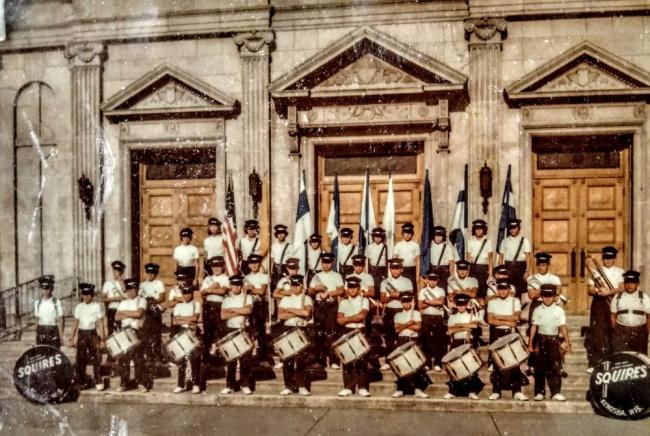
The Queensmen and the group’s younger division, the Queensmen Squires, held a reunion this past weekend, posing for this photo.
The Queensmen were a big part of the Kenosha community some 50 years ago. Yet, today, most don’t know who they were and what they accomplished. In fact, only those with Catholic ties may understand the name of the drum and bugle corps that was active in Kenosha in the 1960s, according to organizer Lou Rugani, “It was named for the queen — Our Lady of the Holy Rosary — based on the Catholic church, but you didn’t have to be Catholic or anything,” Rugani said.
In fact, the corps’ creation stemmed from an even more curious place — a 1963 performance of “The King and I” at St. Joseph’s High School. The story goes, Rugani said, that the priest of Holy Rosary at that time, Father James Tursi, saw the performance and said at a men’s meeting they should start a theater troupe to put on similar performances. However, Rugani’s father urged Tursi to instead focus on forming a drum and bugle corps, as he thought it would be easier and more beneficial to the church.
After a meeting with Tursi, Rugani went about recruiting members for the new corps, which officially came into existence on Jan. 10, 1964. An offshoot group for younger participants also was created. “Our first parade was Memorial Day of that year and we had both corps out there,” he recalled. “And then that summer we went to Mundelein, Ill., for our first parade outside of town, for the Fourth of July. We got pretty good, even our first year. And then, in 1965, we began winning. (In) 1966 we did a lot of winning.”
Kids off the streets
However, it wasn’t about winning, at least for Rugani. The corps was more of a way to give kids seen as outcasts in the community a chance to be part of something — to give them a place they belonged. “That was the idea. You show off. Anybody could join — we took a lot of kids that had never had any friends. They had no experience, nobody wanted to hang around them. We took them in and we made them a star,” he said. During the recruitment process, Rugani would ask kids if they wanted to join, and if they said they couldn’t play an instrument, he’d give them a horn and have them blow into it to make a single note. He’d later write a piece of music where they could play that note and feel like they were part of the group. “Then you send them home with somebody over the weekend,” Rugani said. “Now, they can play three notes. And he comes back the next week, and you say, ‘Hey, you’re great.’ And after six months, he’s good. Now, he’s somebody.” This is how all of the kids who joined the Queensmen started out, more or less, Rugani said, explaining they used the Yamaha method, where kids would “learn by rote.” “Everybody would say, ‘You’re so good. You’re good musicians,’” Rugani said. “We were not musicians. We’d know all these difficult songs, like we played the theme song from ‘Mission Impossible.’ But if you asked us to play ‘Mary Had a Little Lamb,’ we’d be lost.
The method worked out for the Queensmen and the younger division, the Queensmen Squires. Both would go on to win numerous trophies and awards over their six active years from 1964 to 1970, and would stand as one of the top 10 drum and bugle corps in the U.S. Open, one of the major competitions. “Well, we were getting all of these trophies and everything,” Rugani said. “We had to rent a small building — it’s still there, on 44th Place, where that gas station is across from Holy Rosary — that was full of trophies. There was no place to stand or sit hardly anymore. And then we just gave them all away to the kids after we folded.”
A night of danger
Not every trophy came with a glorious story, however, as the Queensmen found out after winning the Tournament of Champions at Riverview Amusement Park in Chicago on Labor Day 1966. “Unfortunately, that was the year Martin Luther King was in Cicero, Ill., and they got attacked by mobs – throwing bottles, bricks, stones, anything. And the Vice Lords came out that night, 1,000 of them to get us or anybody ...,” he recalled. Queensmen members were mugged by the members of the gang, forced to fight back, and some of them were knocked out cold during the battle that ensued inside the amusement park that night. “We couldn’t fight back against that many people,” Rugani said. “These were mean Vice Lords. So this cop, one cop — there was a service road by the roller coaster — took us down that path and we got the hell out of there. I don’t know what happened that night to the rest of the park. They terrorized everybody. But it didn’t influence us, except it was this traumatic experience. People never forgot it.”
Through good times and bad the corps built a strong foundation of camaraderie before time forced corps members to go their separate ways in 1970. “As usual, things change,” he said. “You run out of funds, everybody seemed to hit 21, or Vietnam got in the way.”
The corps did march one last time in 1986 for the Civic Veterans Parade in Kenosha, but now, instead of marching together, they gather from time to time to just reminisce about the old days of being stars in the community.
‘Helped a lot of kids’
Though they received many accolades, Rugani doesn’t focus on those much when looking back, nor does he focus on every tournament or big event they took part in. No, for Rugani — in much the same way it was when he first recruited Queensmen — it all comes back to the kids he was able help, giving them a place, despite whatever else was going on in their life, where they belonged.
“Without friends you turn to other things that are bad for you,” he said. “But we emphasized the rookies right off the street. It was a challenge. We had a lot of good times. And I think we helped a lot of kids.”
Photos